 English
 French


Sustain, innovate, export: The roadmap for the Tunisian automotive industry
Tunisia confirms its strategic role in the automotive sector, and more specifically in the production of components. With nearly 300 active companies and 120,000 jobs, the sector has become a true economic engine, generating nearly 3.9 billion euros in exports per year, of which 37% go to Germany, 21% to France, 12% to Romania and 11% to Italy.
The performance of this sector is supported by a skilled human capital, logistical proximity to Europe, competitive costs and a rise in engineering, software and R&D, which position Tunisia on the value chain of the smart and connected car.
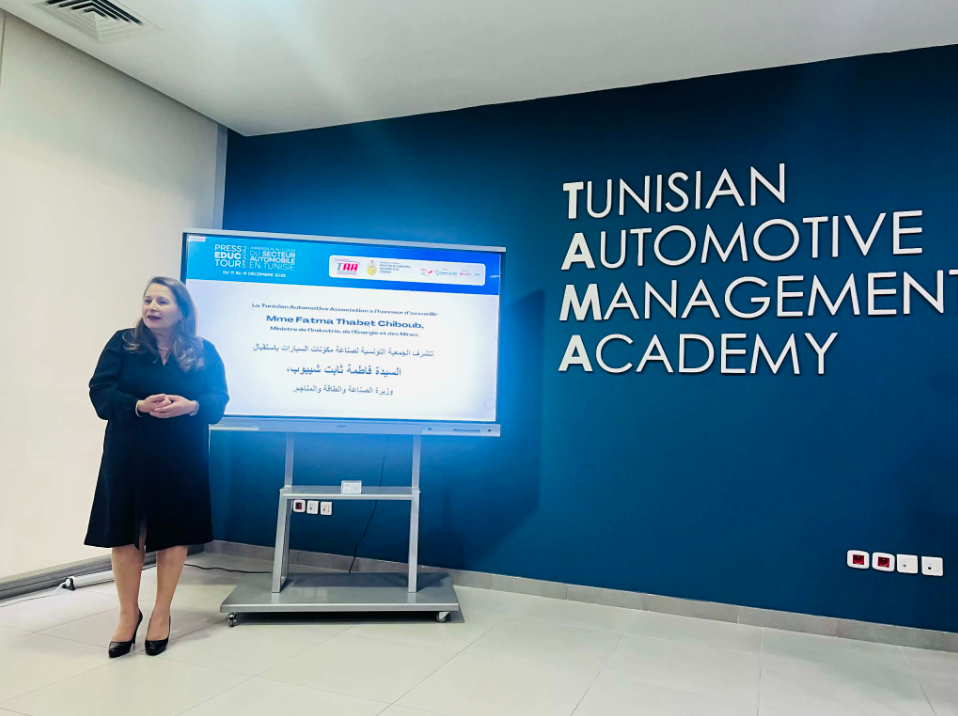
This dynamic was at the heart of the training & eductour entitled “Immersion in the heart of the automotive sector in Tunisia”, organised from 17 to 19 December 2025 by the Ministry of Industry, Mines and Energy, the Tunisian Automotive Association (TAA) and GIZ, for a group of journalists from various media.
The training provided an opportunity to deepen participants' understanding of the challenges, successes, and prospects of the sector, through field visits and presentations by experts. Participants were able to discover Eniso Sousse, the Novation City Incubator, as well as major industrial sites such as Dräxlmaier and TPS Plastivaloire, and later, in Bizerte, PSZ Electronic in Ghezala, illustrating the entire Tunisian automotive ecosystem.
On this occasion, the Minister of Industry, Ms. Fatma Thabet Chiboub, emphasized the strategic role of the media in promoting the automotive components sector and highlighting its strengths at the national and international levels.
“This sector strengthens Tunisia’s position in the Euro-Mediterranean region and in Africa. The ministry, in coordination with all stakeholders, is working to attract large companies, develop new projects, create additional jobs and increase the competitiveness of the sector,” she said, adding that the sector continues to grow to keep pace with global developments, including the transition to clean energy and electric vehicles.
An attractive industrial ecosystem
According to Brahim Debbache, an automotive sector expert, the automotive components sector is now one of the cornerstones of national industry. It contributes significantly to employment and both direct and indirect investment.
According to him, Tunisia has been able to create an attractive industrial ecosystem, thanks to incentive laws and qualified infrastructure, capable of attracting large foreign companies while supporting local players.
“With more than 120,000 jobs and around 300 companies, the sector is one of the largest industrial employers in the country and a key player in the national trade balance. High exports testify to its competitiveness and its ability to integrate into global value chains,” he assured, while adding that Tunisia possesses several distinctive advantages that strengthen the attractiveness of its automotive industry.
According to Mr. Debbache, Tunisia's geographical proximity to Europe offers competitive logistics times. Furthermore, Tunisia's skilled workforce, with its qualified engineers and technicians, is capable of meeting the requirements of international manufacturers. Local companies have adopted advanced technologies and embraced Industry 4.0, integrating engineering, software, and R&D.
The country is also making progress in the field of electric mobility and green energy, offering growth prospects in new mobility solutions. Finally, and no less importantly, the regulatory framework, strengthened by Law 72, encourages foreign and local investment, consolidating Tunisia's position as a leading industrial hub.
This view was shared by Slim Ferchichi, general engineer and director of metal, mechanical, electrical and construction materials industries at the Ministry of Industry, who stated that the Tunisian automotive sector is one of the most promising and strategic in the country.
According to Mr. Ferchichi, with 300 companies, 50% of which have foreign participation, Tunisia now occupies second place in Africa for the production and export of automotive components, attracting both multinationals and supporting local companies established internationally.
The director emphasized the added value and local skills, stressing that Tunisia's industrial and technological capabilities even make it possible to consider the establishment of a car manufacturer in the country.
“Tunisia is also preparing for electric mobility, with financial and tax incentives to support infrastructure and innovation ,” he said, while stressing the importance of simplifying administrative procedures and improving logistics to support investors and strengthen the sector’s competitiveness.
Testimonials and… success stories
The Dräxlmaier Group, a German multinational founded in 1958, established its first international site in Ksibet Sousse in 1974. Today, it has 8 sites in Tunisia and employs 10,600 people, the majority of whom are women.
According to Morched Ben Hamad, Plant Manager, and Jihene Ben Amor, Head of Corporate Communication, the group is a leader in the electrical and interior segments, with plans to expand into component production. Dräxlmaier focuses on customer loyalty and a sense of belonging, a key factor in its success. The company perfectly illustrates Tunisia's industrial upgrading and integration into global premium automotive value chains.
For Chakib Debbabi, CEO of Plastivaloire, the group distinguishes itself through its expertise in plastic injection molding, assembly, and decoration, producing up to 2,000 items per day. In Tunisia, the company has three sites, 850 employees, and more than 60 engineers and technicians. Plastivaloire exemplifies the competitiveness of Tunisian know-how, capable of competing with Asia and surpassing regional competitors like Morocco, all while adhering to the stringent standards of international manufacturers.
Actia designs, manufactures, and operates electronic solutions for land mobility, aeronautics, space, and energy, integrating connectivity, security, and sustainability. Present in 16 countries with over 4,000 employees, including 1,450 engineers and technicians, the Group invests 14% to 18% of its revenue in R&D each year. This comprehensive control over design and production guarantees quality, innovation, and performance for its customers.
Indeed, companies operating in Tunisia consistently demonstrate their excellence both within the country and internationally. The names mentioned are just a few examples from a long list of successes that make the country proud.
Today, all professionals in the sector confirm it: no car circulating in Europe can be produced without at least one of its components having been manufactured in Tunisia, testifying to the quality, expertise and competitiveness of local players on global value chains.
Securing existing infrastructure and investing in engineering
But after several decades of sustained growth, the Tunisian automotive sector is now at a strategic turning point.
According to Sabri Brahem, a member of the TAA steering committee and regional human resources manager at Dräxlmaier, the historical model based on export-oriented mass industry is reaching maturity and showing signs of saturation, requiring a reassessment of sectoral priorities.
The official indicated that the sector's development has largely relied on the initial objectives of Law 72: to strengthen industrial exports and to absorb a large portion of the Tunisian workforce. These objectives have now been achieved: the sector is a driver of employment, a pillar of exports, and a major contributor to industrial value creation, supported by more than 40 years of training and skills development.
Compared to those of competing countries like Morocco or Egypt, the Tunisian industrial fabric has become solidly and competitively structured. However, the sector is facing saturation, particularly for blue-collar profiles.
“Several factors explain this situation: a decline in the birth rate reducing the supply of labor, very high needs per unit of production, reaching up to 9,000 workers per factory, and increased international competition, exacerbated by post-Covid-19 demand. This tension calls into question the sustainability of the labor-intensive model ,” he explained.
He added that Tunisia exports nearly 90% of its automotive production to Europe, a market facing economic and industrial difficulties, regulatory uncertainties surrounding the phasing out of internal combustion engines in 2035, and reduced short-term visibility. This instability directly impacts the historical planning and predictability of the Tunisian sector.
Within this same framework, Sabri Brahem emphasizes a clear imperative: preserving and stabilizing the existing industrial base. The objective is no longer rapid expansion, but the ability to sustainably maintain current production levels over a 9- to 10-year horizon, in order to navigate this period of global transition without eroding the productive fabric. At the same time, automotive engineering and design represent a major strategic opportunity.
Tunisia has established itself as a credible destination for automotive design, software engineering, and the development of technical solutions for global markets. Rising costs in developed countries, combined with the quality of Tunisia's human capital, are driving this growth. Each year, 8,000 to 10,000 engineers are trained in the country, representing a major competitive advantage.
“Some multinationals have already begun this transition by establishing small teams of engineers in Tunisia. The challenge today is to scale up, structure this positioning and attract more international players. This requires proactive communication about Tunisia's potential and an environment conducive to continuous improvement, which is essential in a sector subject to strong global competition ,” he further explained.
In this respect, the Tunisian automotive sector can no longer be conceived solely as a mass-production industry. Its sustainability depends on its ability to secure its industrial assets, capitalize on its highly skilled workforce, and fully integrate into global automotive engineering and design value chains. Only then will Tunisia be able to transform its current constraints into drivers of lasting competitiveness.
This is to say that the sector is resolutely looking to the future, driven by several flagship initiatives. The Smart Automotive City, spanning 300 hectares, will integrate factories, R&D laboratories, training centers, and technology hubs, with the potential to create 150,000 jobs in the medium and long term. The transition to electric and connected vehicles represents an opportunity to enhance local production and foster innovation. The Pact for the Competitiveness of the Automotive Industry, signed by public and private stakeholders, aims to increase employment and exports, while consolidating the upgrading of Tunisian companies. The sector is also focusing on developing engineering and high-value-added services, particularly in software, design, and electronic components.
Thus, the Tunisian automotive components industry is now a strategic sector, combining employment, exports, and innovation. Local and multinational companies have successfully capitalized on the country's strengths while addressing challenges related to the workforce, the energy transition, and international competition.
And with structuring projects, continuous upgrading and a dynamic R&D ecosystem, Tunisia is positioning itself as an essential hub for the mobility of the future, capable of meeting the demands of European and international markets and actively contributing to the smart, connected and sustainable car.
Meriem KHDIMALLAH - La Presse
Source: https://www.lapresse.tn/2025/12/25/perenniser-innover-exporter-la-feuille-de-route-de-lautomobile-tunisienne/