 English
 French


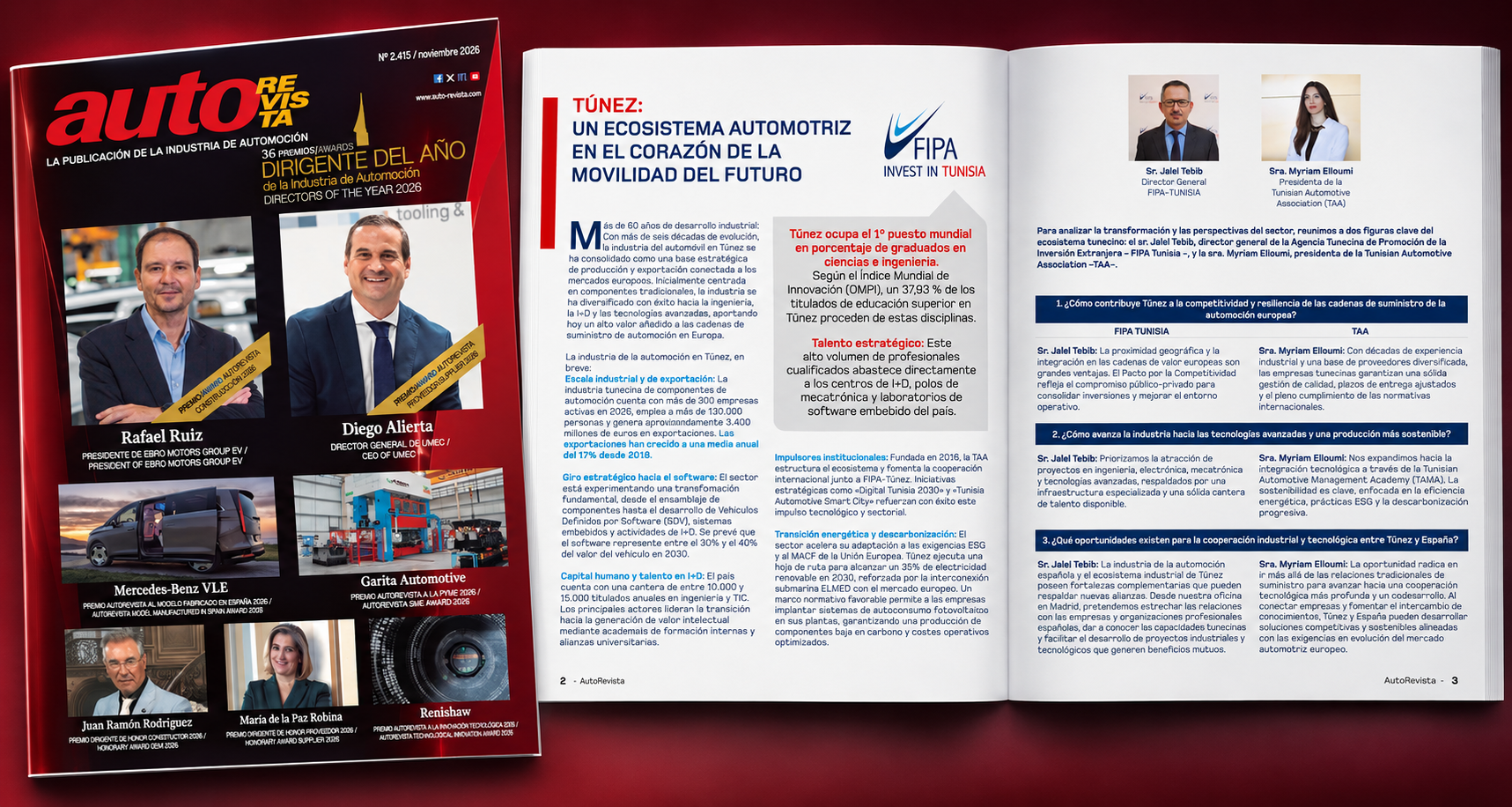
AutoRevista devotes a special feature to the Tunisian automotive ecosystem and its technological potential
Tunisia at the heart of the mobility of the future: In its November 2026 issue, the Spanish magazine AutoRevista, a leading publication in the automotive industry, devotes a special feature to the Tunisian automotive ecosystem. Produced with the participation of the Tunisian Automotive Association (TAA) and the Foreign Investment Promotion Agency (FIPA-Tunisia), this report highlights the sector's performance, its technological capabilities, and new prospects for industrial cooperation between Tunisia and Spain.
Entitled "Tunisia: An Automotive Ecosystem at the Heart of the Mobility of the Future," this report reviews several Initially focused on the manufacture of traditional components, the industry has gradually diversified its activities into engineering, research and development (R&D), and advanced technologies.
A Tunisian automotive industry undergoing transformation
The report highlights the industrial and export dimension of the Tunisian automotive sector, which in 2026 will have more than 300 companies. Since 2018, the sector's exports have shown an average annual growth of 17%.
This momentum is accompanied by a strategic shift toward higher value-added activities, including embedded systems, software development, and Software-Defined Vehicles (SDVs). By 2030, software could account for between 30% and 40% of a vehicle's value.
Human capital is also a major asset. Tunisia has a talent pool estimated at between 10,000 and 15,000 graduates per year in engineering and information and communication technologies (ICT). According to data from the World Intellectual Property Organization (WIPO) cited in the dossier, 37.93% of Tunisian higher education graduates come from science and engineering backgrounds.
Leading industrial and technological players
The dossier highlights several international companies and Tunisian groups that are contributing to the automotive industry's move upmarket. Through training initiatives, including the Tunisian Automotive Management Academy (TAMA), the association also supports the development of skills and the adaptation of the sector to new technological and industrial requirements.
The energy transition and decarbonization are also among the priorities addressed, with a particular focus on energy efficiency, ESG practices and integration. The complementarities between the two ecosystems open up opportunities for partnerships in several strategic areas:
- Embedded software and SDVs: Software development for electronic control units (ECUs), cybersecurity and connectivity.
- Mechatronics and smart components: integration of electronic control systems He emphasized the importance of evolving industrial relations between the two countries toward integrated partnerships based on engineering, innovation, knowledge sharing, and co-development.
Cooperation based on concrete opportunities
The testimony of Jaime Samón Viñas, CEO of Suministros ARSAM S.A., illustrates the positive experience of Spanish companies established in Morocco. The company particularly highlights the quality of the industrial environment, the skills of local professionals and the support of Tunisian institutions, with prospects for developing its activities and investments in the country.
Through this publication in AutoRevista, TAA and FIPA-Tunisia are helping to enhance the industry's international visibility.