 English
 French


Tunisia: Strengthening the role of the media in promoting the automotive components industry
For several years, the automotive industry in Tunisia has been engaged in a process of continuous adaptation to respond to the rapid evolution of the international market and increasingly intense competition. By 2025, the sector will comprise more than 280 active companies—a number that has more than doubled since 2000—enabling Tunisia to become the second-largest producer of automotive components in Africa.
This strategic sector is undergoing a profound transformation of its value chain, marked by a gradual shift in global supply and demand towards emerging countries. This evolution has led to a significant geographical redeployment of production capacities on an international scale.
Training the media to better promote a strategic sector
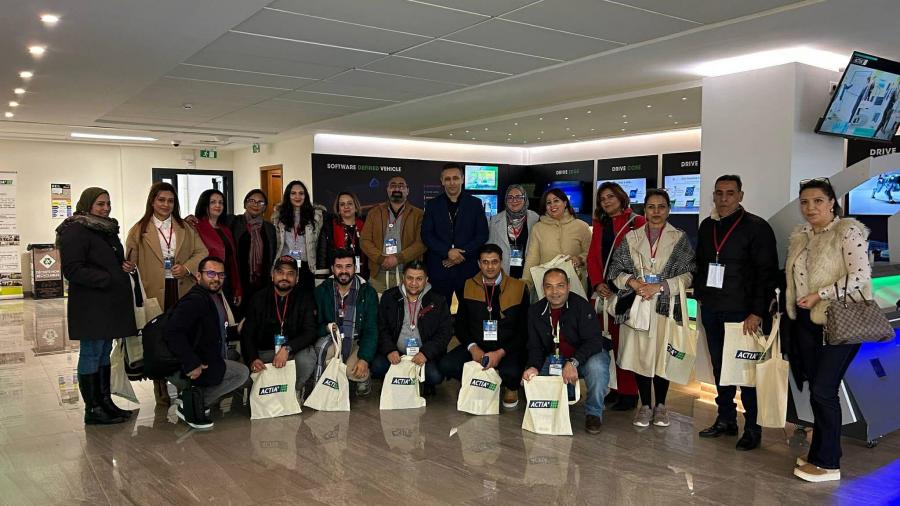
With the aim of strengthening the role of the media in promoting this rapidly expanding sector, which attracts new international investors every year, the Ministry of Industry, Mines and Energy organised, in partnership with the Tunisian Automotive Association (TAA) and with the support of GIZ Tunisia, a training session for a wide range of journalists, combined with an Eductour.
This initiative aimed to introduce media professionals to a sector that is still undervalued, despite its considerable economic weight: more than 120,000 jobs and nearly 3.9 billion euros in exports, with an estimated average annual growth of 16%.
During the inaugural session, Slim Ferchichi, director of metallurgical, mechanical and electrical industries at the Directorate General of Manufacturing Industries at the Ministry of Industry, Mines and Energy, stressed that the automotive sector constitutes a strategic pillar of the Tunisian economy and benefits from the full support of the State, given its high added value and its contribution to national exports.
He also noted that Tunisia now occupies the second position in Africa in terms of exports of automotive components, specifying that Germany is the leading destination with 37%, followed by France (21%), Romania (12%) and Italy (11%).
Immersion in the heart of the Tunisian automotive ecosystem
During the training, the journalists visited several major industrial companies located in the regions of Sousse, Tunis and Bizerte, including TPS Plastivaloire, DRÄXLMAIER, PSZ Electronic and ACTIA…
These visits allowed participants to discover the emergence of a complete industrial ecosystem, covering all the professions in the sector: electrical harnesses, mechanics, plastic components, electronics, software engineering, spare parts and mobility solutions.
Competitiveness driven by human capital and innovation
Thanks to state-of-the-art production units, a skilled workforce, competitive costs and a high rate of graduates from scientific and technical fields, Tunisia has distinctive advantages reinforced by its strategic geographical position, close to European ports, and by a network of trade agreements covering nearly 100 countries.
Wages, social security contributions, and energy costs are among the most attractive in the region, creating a favorable environment for industrial investment. This competitiveness is further supported by a surge in innovation.
Media representatives noted that the Tunisian automotive industry is resolutely moving towards future technologies. Several international groups, such as Dräxlmaier, Visteon, ACTIA, KPIT and Ampere, have established development centers in Tunisia specializing in embedded systems, automotive software, electronics and electric mobility solutions.
This dynamic is supported by a network of specialized structures, including the Centre for Technological Resources (CRT), the Centre for Research in Microelectronics and Nanotechnology (CRMN) and the Technical Centre for Rubber and Plastics (CTC).
The Automotive Smart City: a structuring project
Among the major projects is the Automotive Smart City, the first smart industrial zone dedicated to the automotive sector in Tunisia. Designed within the framework of a public-private partnership, this project aims to increase production capacity, improve industrial quality and accelerate the sector's upgrading.
The future industrial park will cover 200 hectares and will include modern industrial units, research and development laboratories, training centers, and spaces dedicated to new technologies. Ultimately, this project is expected to create up to 150,000 jobs.
The central role of the Tunisian Automotive Association
The training also enabled journalists to better understand the key role played by the Tunisian Automotive Association (TAA) in the development of the automotive sector in Tunisia. The association supports Tunisian investors, promotes the sector internationally, attracts foreign investors, and contributes to resolving structural issues, particularly in the area of export transportation.
Founded in 2016, the TAA brings together more than 80 companies, representing nearly 80% of the sector's employment. It has created its own academy, the Tunisian Automotive Management Academy (TAMA), dedicated to supporting investors in the sustainable transition and the adoption of international standards (ESG, VDA QMC, CSDDD).
The signing of the Pact for the Competitiveness of the Automotive Industry in 2022 marks a decisive step in strengthening the partnership between the public and private sectors.
The training session concluded under the auspices of the Minister of Industry.
The training session concluded with a reception at TAA headquarters, presided over by the Minister of Industry, Mines and Energy, Ms. Fatma Thabet Chiboub, who presented certificates to the participating journalists.
In her address, the minister emphasized the essential role of the media in promoting this promising sector and showcasing Tunisia's strengths both nationally and internationally. She reaffirmed the ministry's commitment to supporting all stakeholders in order to overcome obstacles, encourage local investment, attract foreign investors, launch new projects, create more jobs, and enhance Tunisia's competitiveness as a business location.
A successful media immersion
Ultimately, these three days of training enabled journalists to gain a comprehensive and in-depth understanding of the potential of the Tunisian automotive sector. This joint mobilization of public and private stakeholders represents a key lever for opening up new investment opportunities, particularly with international partners.
Driven by its industrial dynamism, the quality of its talent, its innovation strategy and its strategic geographical position, Tunisia has all the assets to establish itself as a leading center of the automotive industry in Africa and in the Euro-Mediterranean region.
Fathi Tlili -espacemanager.com
Source: https://www.espacemanager.com/tunisie-renforcement-du-role-des-medias-dans-la-promotion-de-lindustrie-des-compeuts-automobiles